
Altitude sickness is a real risk on the Everest Base Camp Trek, but it is largely manageable. The main tools are gradual ascent, honest symptom reporting, and never going higher while symptoms are present. Everest Base Camp sits at about 5,364 m (17,598 ft), and Kala Patthar at about 5,545 m (18,192 ft). Your risk depends on how fast your sleeping altitude rises, how well you acclimatize, and your individual susceptibility, not on fitness alone. This guide covers symptoms, prevention, medication questions and emergency steps.
What Is Altitude Sickness?
Air pressure drops as you climb, so each breath delivers less oxygen. The CDC Yellow Book notes that at about 3,050 m, the oxygen available in each breath is only about 69% of sea-level levels. It is lower still near Everest Base Camp. Your body adapts by breathing faster and adjusting circulation, but this takes time.
Altitude illness comes in three forms:
- Acute Mountain Sickness (AMS): The most common and usually mildest form. It feels much like a bad hangover.
- High-Altitude Cerebral Edema (HACE): Brain swelling that affects thinking and balance. It is rare but a medical emergency.
- High-Altitude Pulmonary Edema (HAPE): Fluid in the lungs. It is a medical emergency and can worsen quickly.
AMS is generally less severe than HACE or HAPE. However, CDC describes HACE as “end-stage” AMS, which is why untreated AMS must not be ignored.
Why Is Altitude Sickness a Risk on the Everest Base Camp Trek?
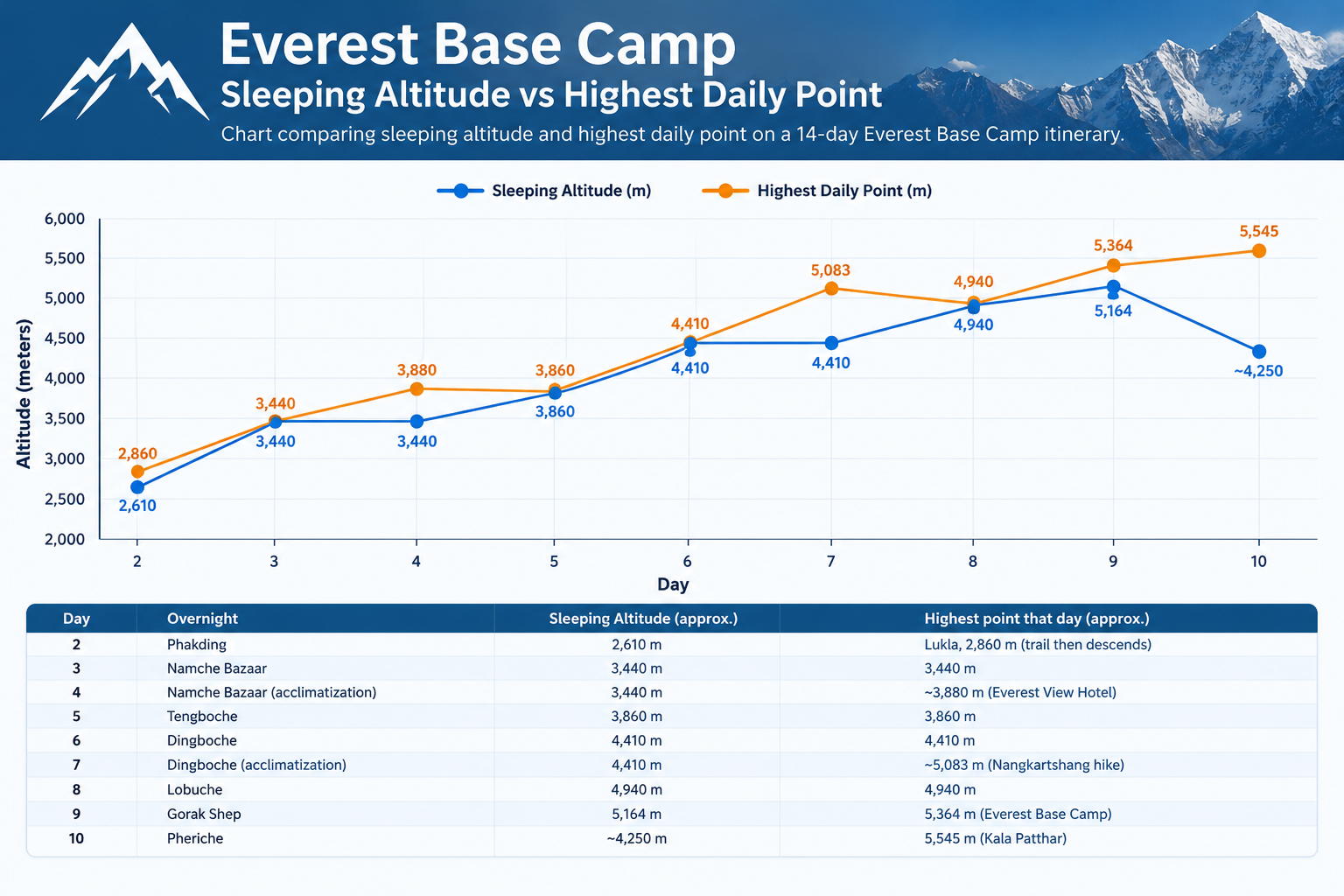
Most trekkers fly to Lukla (about 2,860 m) and reach Namche Bazaar (about 3,440 m) the next day. CDC’s Nepal chapter notes that Everest-region trekkers routinely sleep at roughly 4,267–5,150 m and hike above 5,486 m. CDC also says these itineraries “push the limits” of many people’s ability to acclimatize, and that extra days can make the trip safer.
Sleeping altitude matters more than the highest point you visit. A day hike to a high viewpoint followed by a night lower down puts less strain on the body than sleeping at that height. CDC notes that hypoxia is greatest during sleep.
The table below shows the nightly profile of our published 14-day itinerary.
| Day | Overnight | Sleeping altitude (approx.) | Highest point that day (approx.) |
|---|---|---|---|
| 2 | Phakding | 2,610 m | Lukla, 2,860 m (trail then descends) |
| 3 | Namche Bazaar | 3,440 m | 3,440 m |
| 4 | Namche Bazaar (acclimatization) | 3,440 m | ~3,880 m (Everest View Hotel) |
| 5 | Tengboche | 3,860 m | 3,860 m |
| 6 | Dingboche | 4,410 m | 4,410 m |
| 7 | Dingboche (acclimatization) | 4,410 m | ~5,083 m (Nangkartshang hike) |
| 8 | Lobuche | 4,940 m | 4,940 m |
| 9 | Gorak Shep | 5,164 m | 5,364 m (Everest Base Camp) |
| 10 | Pheriche | ~4,250 m | 5,545 m (Kala Patthar) |
On this itinerary, sleeping altitude rises about 830 m from Phakding to Namche, 420 m to Tengboche, 550 m to Dingboche, 530 m to Lobuche and about 225 m to Gorak Shep. Some of these gains are larger than the roughly 500 m per night figure in the guidelines below. Those guidelines are general, and the itinerary includes two acclimatization days. Still, it is a good reason to take symptom monitoring seriously.
Symptoms of Altitude Sickness on the Everest Base Camp Trek
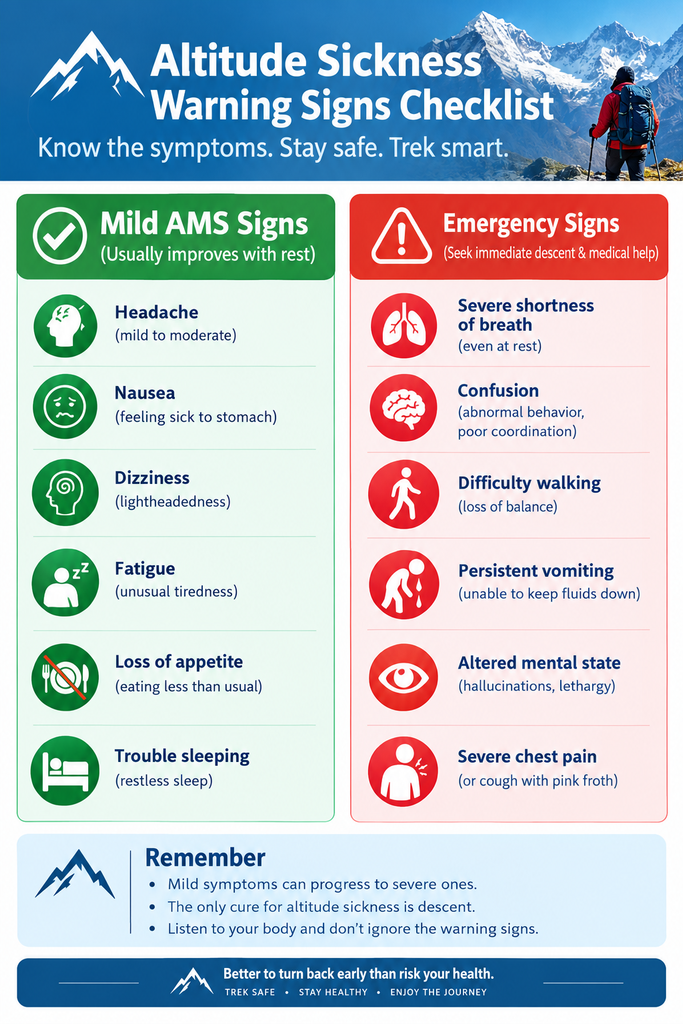
Early Symptoms of Acute Mountain Sickness
Headache is the main symptom, usually with at least one of the following:
- Loss of appetite or nausea (sometimes vomiting)
- Dizziness
- Unusual tiredness or fatigue on minimal effort
- Poor sleep
The Nepal Tourism Board says that if you feel unwell above 2,500 m, treat it as AMS until proven otherwise.
Warning Signs of Severe Altitude Illness
These signs can point to HACE or HAPE and need urgent action, not more sleep, water or waiting:
- Confusion, unusual drowsiness or behavior changes
- Loss of coordination: walking “like a drunk” or unable to walk a straight line
- Breathlessness at rest
- Persistent cough or chest congestion, especially with worsening breathlessness or pink or bloody sputum
- Severe or rapidly worsening symptoms, or marked weakness
CDC notes that HAPE can be more rapidly fatal than HACE. Coma can follow within 12–24 hours of the onset of poor coordination if HACE goes untreated.
When Do Altitude Sickness Symptoms Usually Start?
According to CDC, AMS symptoms usually start 2–12 hours after arriving at a new altitude or climbing higher, often during or after the first night. AMS typically resolves in 12–48 hours if you do not ascend further.
Timing varies, and feeling fine on arrival does not make you safe. Stay alert after every move to a higher sleeping altitude. If symptoms start after three or more days at the same altitude without further ascent, CDC says AMS is not the likely cause. Other causes, including infection, need assessment.
How to Prevent Altitude Sickness on the Everest Base Camp Trek
No checklist eliminates altitude illness. These steps reduce risk, according to CDC, the Wilderness Medical Society and NTB:
- Ascend gradually. Slow, staged ascent is the foundation of prevention.
- Choose an itinerary with acclimatization days. Extra days make the trek safer.
- Manage sleeping-altitude gains. See the guidelines below.
- Never ascend to sleep higher while you have symptoms, however minor they seem.
- Keep a steady pace. CDC recommends only mild exercise for the first 48 hours at altitude.
- Eat and drink regularly. Good hydration supports general health but does not prevent altitude sickness on its own. Dehydration can also mimic AMS.
- Avoid alcohol for the first 48 hours at high altitude.
- Keep your usual caffeine intake if you normally drink it. Withdrawal headaches can be mistaken for altitude headaches.
- Talk to a clinician before you travel about your personal risk and whether preventive medication suits you.
Fitness does not protect you. CDC states that training and physical fitness do not affect altitude illness risk. Children are as susceptible as adults. Pulse oximeter readings are one data point only. They do not diagnose AMS or clear you to ascend.
If you have heart or lung disease, sleep apnea, sickle cell trait, or are pregnant, see a physician familiar with high-altitude medicine before booking.
The Importance of Acclimatization Days
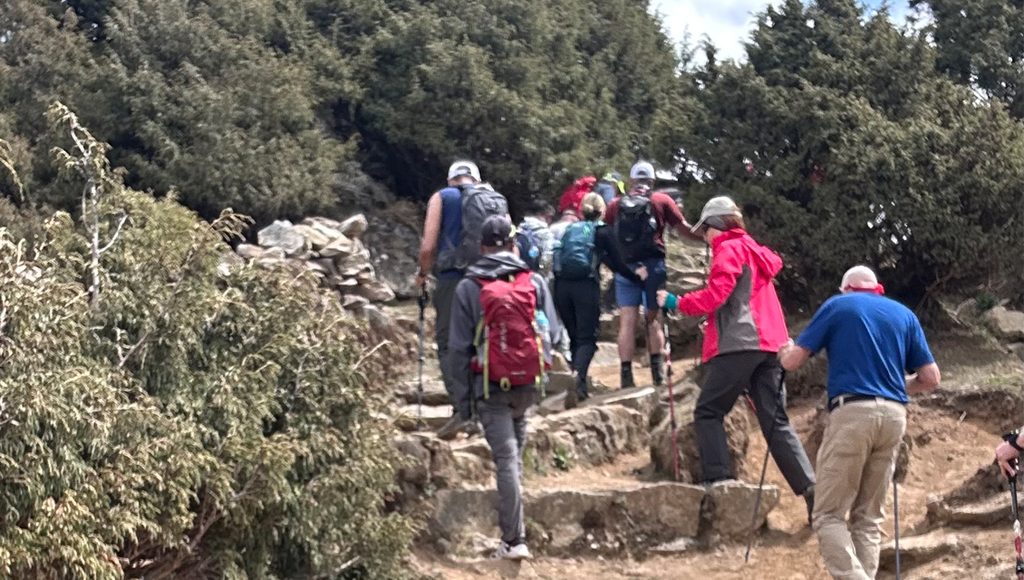
Acclimatization is the body’s gradual adjustment to lower oxygen. CDC says the crucial acute phase takes about 3–5 days after ascent. Altitude illness can develop before it is complete.
Our itinerary has two dedicated days: Namche Bazaar (Day 4) and Dingboche (Day 7). On each, trekkers hike higher by day and return to sleep lower, the “climb high, sleep low” principle. Use these days for a short hike rather than complete rest if your guide advises it.
Guideline figures (WMS recommendations as summarized by CDC):
- Avoid going from low altitude to a sleeping altitude of 2,750 m or more in one day.
- Above 3,000 m, increase sleeping altitude by no more than about 500 m per night.
- Add an extra night for every 1,000 m of sleeping-altitude gain.
NTB gives a similar rule: 300–500 m per day above 2,500 m, with a rest day after every 1,000 m gained.
CDC adds that these recommendations “can still be too fast for some travelers and too slow for others.” Some people need a slower ascent or extra days.
Can You Prevent Altitude Sickness With Medication?
A qualified clinician may recommend acetazolamide (often called Diamox) to help prevent AMS. CDC notes it speeds acclimatization, and its Nepal chapter says it can substantially lower the chance of AMS around Namche. Whether it suits you is an individual decision.
Discuss these points at a pre-travel consultation:
- Whether your itinerary and history justify preventive medication
- Dose and timing, which depend on your circumstances
- Allergies, other medicines and medical conditions
- Possible side effects, such as tingling in the fingers and toes, more frequent urination and altered taste of fizzy drinks
- Whether to carry an emergency medicine kit
Medication does not replace gradual ascent or descent. Do not self-prescribe, and do not start prescription medicine at altitude without medical advice.
What Should You Do If You Develop Altitude Sickness During the Trek?
CDC gives three rules that apply to every trekker:
- Know the early symptoms and admit when you have them.
- Never ascend to sleep at a higher altitude with symptoms.
- Descend if symptoms worsen despite rest or treatment.
If you suspect mild AMS
- Stop going higher. Do not move to a higher sleeping altitude.
- Tell your guide or companion immediately.
- Rest and re-check symptoms over the next hours.
- Follow medical advice and the trek’s emergency procedures.
- Descend if symptoms get worse or do not improve. CDC notes AMS often improves quickly after descending 300 m (1,000 ft) or more.
If you suspect HACE or HAPE
- Treat it as a medical emergency.
- Descend now, with help, and arrange urgent medical assistance.
- Never leave the person alone.
- Use supplemental oxygen or emergency treatment only when available and under appropriate guidance.
- Arrange evacuation when indicated and feasible.
Do not wait for symptoms to become severe. Weather, terrain and rescue limits can complicate emergencies. CDC’s Nepal chapter notes that helicopter rescue is usually limited to morning hours because of afternoon winds, and flights depend on weather.
HRA aid post at Pheriche. The Himalayan Rescue Association runs an aid post at Pheriche (about 4,250 m). NTB lists a free daily altitude talk at 3 pm there during the spring and autumn seasons. The post is staffed by volunteer doctors only during those seasons, so confirm current details with your guide.
Can You Continue Trekking if You Have a Headache?
A headache after a recent ascent should be taken seriously. Dehydration, cold, fatigue and caffeine withdrawal can also cause headaches. But a headache with nausea, dizziness, unusual fatigue or poor appetite may be AMS.
Pain relief can ease the headache. It does not make it safe to climb, and you should not use it to mask symptoms so you can keep ascending. Do not go to a higher sleeping altitude while you have symptoms. Tell your guide, rest, and reassess.
Does Travel Insurance Cover Altitude Sickness and Helicopter Evacuation?
It depends on the insurer and the exact wording of your policy. Check these points before you buy:
- Does it cover trekking to the maximum planned altitude (5,545 m on this itinerary)?
- Does it cover emergency medical treatment and, where applicable, search and rescue?
- Does it cover helicopter evacuation?
- What are the exclusions and pre-authorization rules?
- How do you contact the assistance provider?
CDC notes that helicopter rescue in Nepal is billed at roughly USD 4,000 per hour, with an average total of USD 8,000–10,000. Evacuation policies generally require that the rescue be arranged through the insurer, or the traveler bears the cost. Some insurers no longer cover Nepal or add a surcharge.
For this trek, our package requires insurance covering trekking to the maximum altitude and helicopter evacuation, and we check policy wording before departure from Kathmandu.
Is the Everest Base Camp Trek Safe for Beginners?
Many first-time trekkers complete it with suitable preparation, a sensible itinerary and responsible decisions. Altitude illness cannot be completely eliminated, and the trek is not right for everyone.
What helps most:
- Fitness and hiking practice. These make the walking days easier. They do not prevent AMS.
- Prior altitude exposure. CDC says a previous altitude exposure is the best guide only if the altitude and rate of ascent were similar, and even then it is not infallible.
- Realistic pacing and enough days.
- Willingness to stop or descend, which is the most important safety habit.
Prepare for Everest Base Camp With Everest Trek Guides
Our 14-day Everest Base Camp Trek reaches 5,364 m at Base Camp and 5,545 m at Kala Patthar. It includes two acclimatization days, in Namche Bazaar and Dingboche. The package also lists a guide-carried first-aid kit, basic pulse-oximeter checks at higher camps, and a pre-trek briefing covering altitude. Our guides will not push clients who need an extra rest day or a descent.
An itinerary with acclimatization days supports responsible planning, but no guide, itinerary or device eliminates altitude sickness. Longer options also exist, such as our 17-day route via Gokyo Lakes.
Review the itinerary, then ask our team about acclimatization arrangements and emergency procedures before you book.